Your Brain on the Almost-Win: What's Really Happening When You Can't Walk Away
Photo: Unknown, Public domain, via Wikimedia Commons
You've been there. Three symbols line up on the screen, and then — just barely — the fourth doesn't. Or you scratch off a lottery ticket and reveal two out of three matching numbers. Or you're holding a pair of aces when the river card doesn't cooperate. Whatever the game, whatever the venue, that gut-punch moment of almost is one of the most powerful forces in all of gaming. And it's not accidental.
Pennsylvania has one of the most robust gaming ecosystems in the country — more than a dozen casinos, a state lottery that generates billions in annual revenue, and a thriving bar and social gaming scene that stretches from Pittsburgh's South Side to the Jersey-border towns of the Lehigh Valley. All of that activity means millions of Pennsylvanians are regularly experiencing what researchers call the "near-miss effect" — and for many of them, that experience is doing something very specific to their brains.
What a Near-Miss Actually Does to Your Brain
Dr. Leanne Farris, a behavioral psychologist who consults with gaming wellness programs in the Philadelphia area, puts it simply: "A near-miss activates the same reward circuitry as an actual win — but it doesn't satisfy it. You get the dopamine hit without the resolution. Your brain essentially files it under 'unfinished business' and keeps pushing you to close the loop."
That's not a bug in the gaming experience. In many cases, it's a feature — one that's been carefully studied and, in some contexts, deliberately engineered. Slot machines in Pennsylvania's licensed casinos are regulated by the Pennsylvania Gaming Control Board, which sets strict parameters on how games are designed and what outcomes are possible. But within those parameters, the psychological architecture of a near-miss is real and measurable.
Functional MRI studies have shown that near-misses trigger activity in the insula and the striatum — regions of the brain associated with anticipation, motivation, and emotional processing. In other words, your brain treats a close call like a reason to try again, not like a loss. That's a crucial distinction.
The Lottery Angle: Scratchers and the Illusion of Almost
If you've ever scratched a Pennsylvania Lottery ticket and found yourself thinking, "I was so close," you're not imagining things. The design of instant scratch-off games often incorporates near-miss mechanics — not to deceive players, but because the format naturally produces them. Matching two of three symbols, coming up one number short on a prize tier, revealing a "bonus" symbol that doesn't quite unlock a bigger payout — all of these create that same neurological itch.
Marcus T., a 44-year-old from Allentown who describes himself as a "reformed daily scratcher," knows the feeling intimately. "I'd spend maybe $20 on tickets, win $5, and then convince myself I was on the edge of something. The almost-wins were almost worse than losing outright, because they kept me in the game."
He eventually connected with a counselor through the Pennsylvania Council on Problem Gambling (PCPG), a state-funded resource that offers free help to anyone struggling with gaming-related issues. "They helped me understand that I wasn't weak — my brain was just doing what brains do. Once I understood the mechanism, I could actually work with it."
Card Tables and the Near-Miss in Disguise
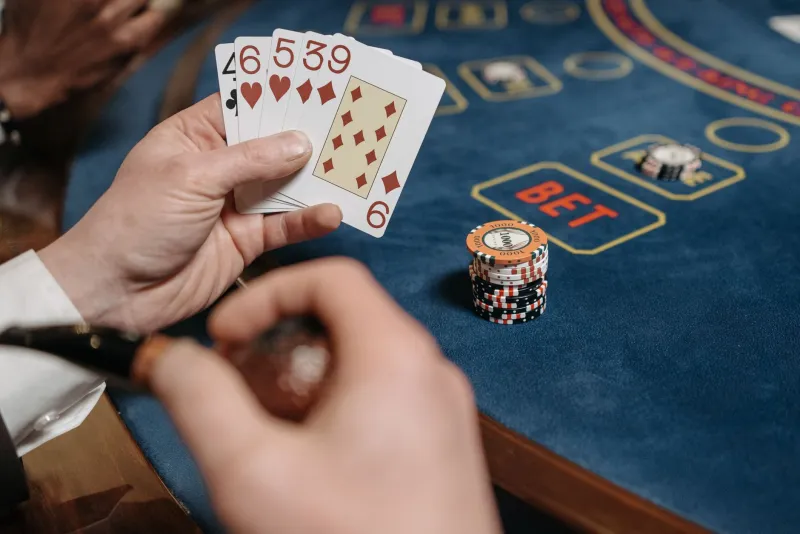
Poker and blackjack players often insist their games are different — and in some ways, they're right. Skill plays a real role, and the near-miss effect operates differently at a card table than at a slot machine. But it's still there.
At the poker table, it often shows up as what players call a "bad beat" — a hand where the math was on your side and the cards just didn't cooperate. Losing with a full house to four-of-a-kind isn't just disappointing; it triggers a similar neurological response to a slot near-miss. You were supposed to win. Your brain knows it. And that sense of injustice becomes its own motivator to keep playing.
Gaming counselor Jerome Whitfield, who works with clients in the Pittsburgh metro area, says this is one of the trickier aspects of helping card players recognize problematic patterns. "They'll say, 'I'm not like a slot junkie — I'm playing a skill game.' And that's partly true. But the emotional response to a near-miss is the same regardless of the game. The brain doesn't care about the rules."
How Pennsylvania Venues Are Responding
It's worth noting that Pennsylvania's licensed gaming operators are required by law to promote responsible play. Every casino on the floor must display information about problem gambling resources, and many have trained staff who are empowered to initiate conversations with guests who appear to be in distress. The PGCB also mandates self-exclusion programs, which allow players to voluntarily ban themselves from gaming venues statewide.
Beyond compliance, several Pennsylvania casinos have developed voluntary responsible gaming programs that go further — offering players the ability to set daily spending limits, cooling-off periods, and session time reminders. Some venues have even experimented with ambient cues, like natural lighting and clocks on the gaming floor, to help players maintain a realistic sense of time.
Recognizing the Line Between Fun and Fixation
For the vast majority of Pennsylvania players, the near-miss is just part of the thrill — an emotional texture that makes gaming exciting. The rush of almost-winning is what makes actually winning feel meaningful. That's a completely healthy relationship with games of chance.
But for somewhere between 1% and 3% of the adult population, according to national estimates, that mechanism becomes something harder to manage. The PCPG recommends watching for a few key warning signs: chasing losses with bigger bets, gaming to escape stress or anxiety, hiding gaming activity from family members, or feeling irritable when you try to cut back.
If any of those resonate, the council's helpline — 1-800-GAMBLER — is available 24 hours a day, and it's free. No judgment, no lectures, just support.
Play Smart, Play Aware
Understanding the psychology of the near-miss doesn't mean you have to stop enjoying your favorite games. It means you can enjoy them more consciously. Set a budget before you sit down. Decide in advance how long you'll play. Treat any winnings as a bonus, not a baseline.
Pennsylvania has built one of the country's most regulated and transparent gaming environments precisely because the state takes player welfare seriously. Take advantage of that. Know the resources. Know your own patterns. And the next time a slot stops one symbol short of a jackpot, you can appreciate the thrill — and then walk away with a smile.